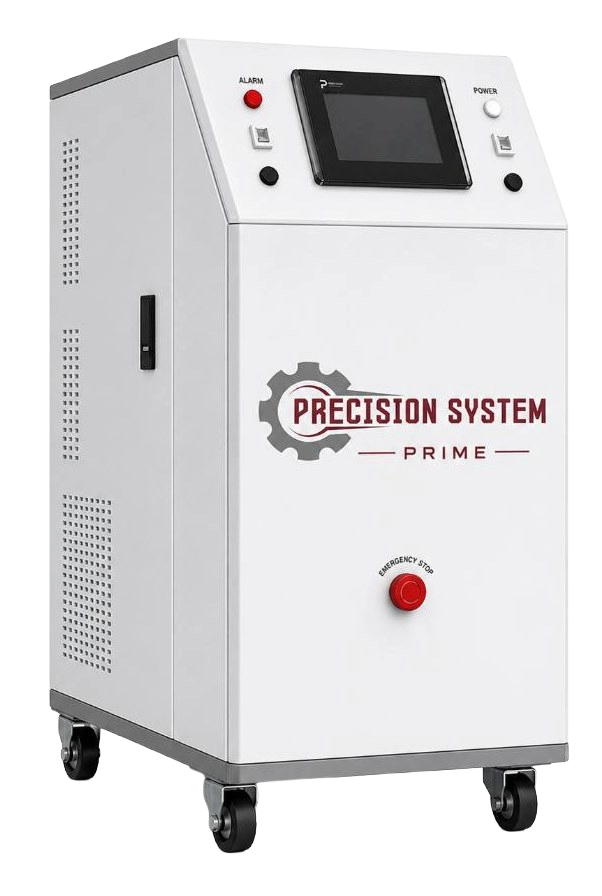
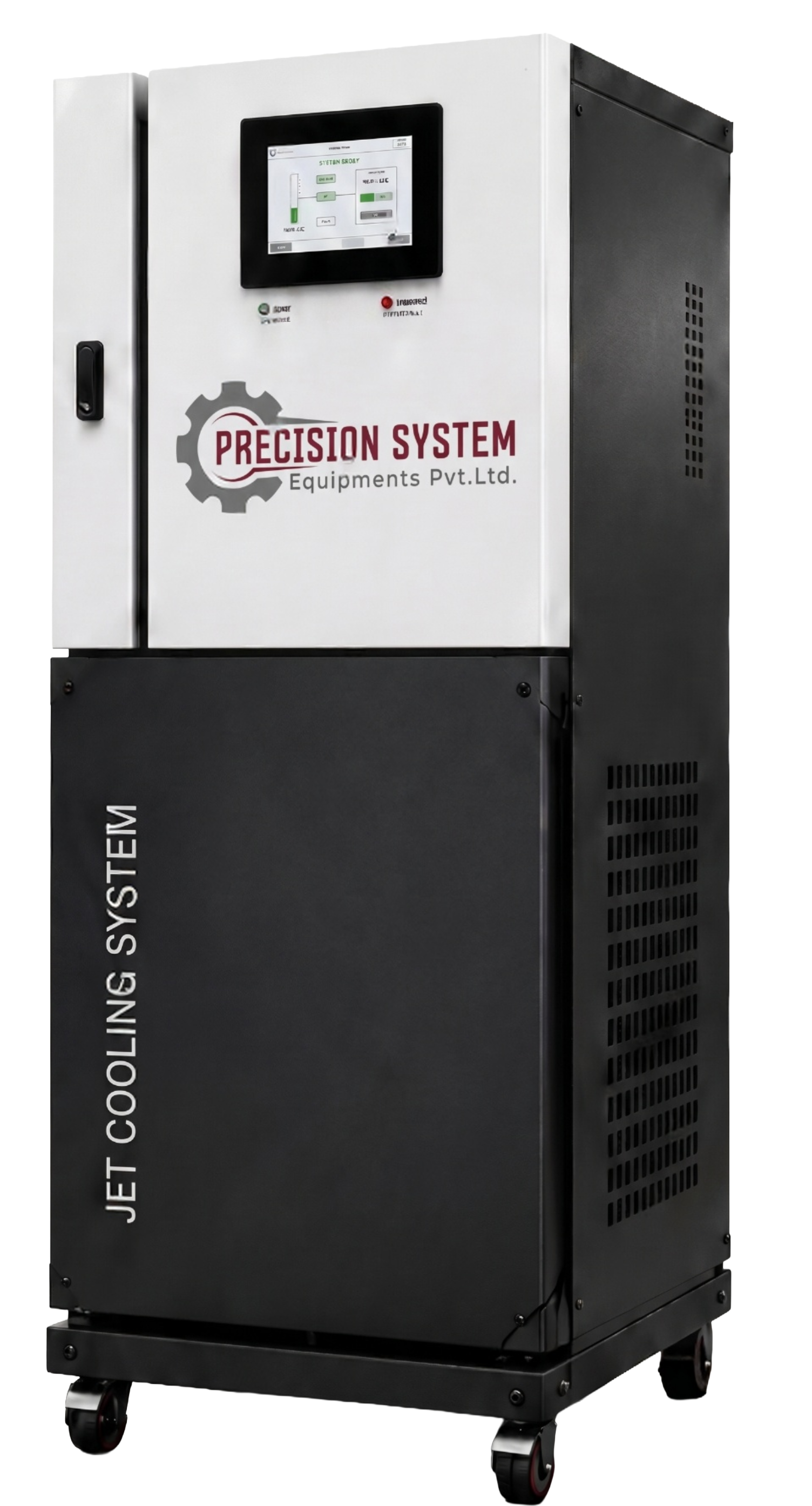
PRECISION PRIME is the entry point to jet cooling: efficient, reliable die cooling for small to medium die casting setups, without the complexity.
It drives cooling water at high velocity into the die's hot spots — the thin sections and core pins that ordinary line cooling never reaches — so the casting solidifies sound instead of tearing itself apart as it cools.
Plug & play operation and low maintenance cost, suitable up to 20 pins.
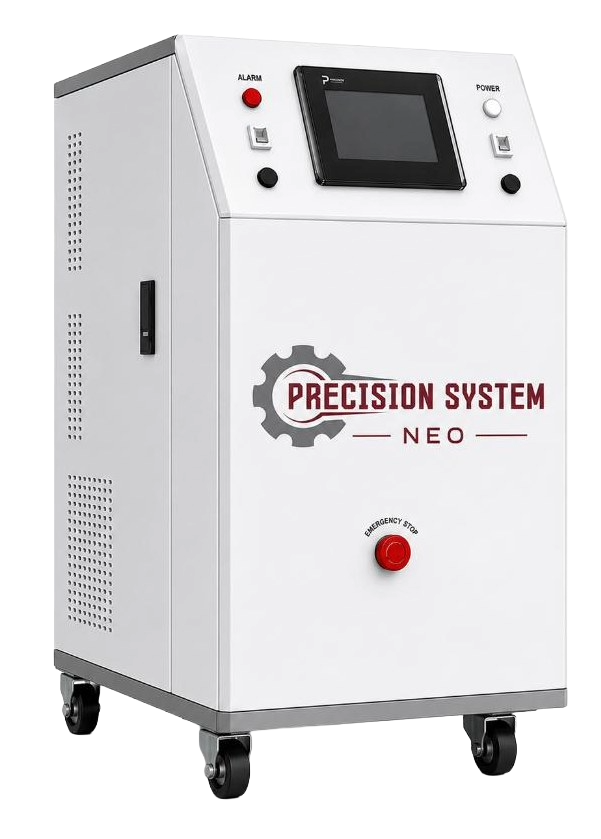
PRECISION NEO is proven and reliable jet cooling technology, built for high performance and consistent casting quality shot after shot.
It is the machine to reach for when the defect sits in thin sections and around core pins — the places where shrinkage porosity starts and where cooling has to be precise, not merely present.
Casters trust this plug & play machine for its optimal cost-performance and its international standard components.
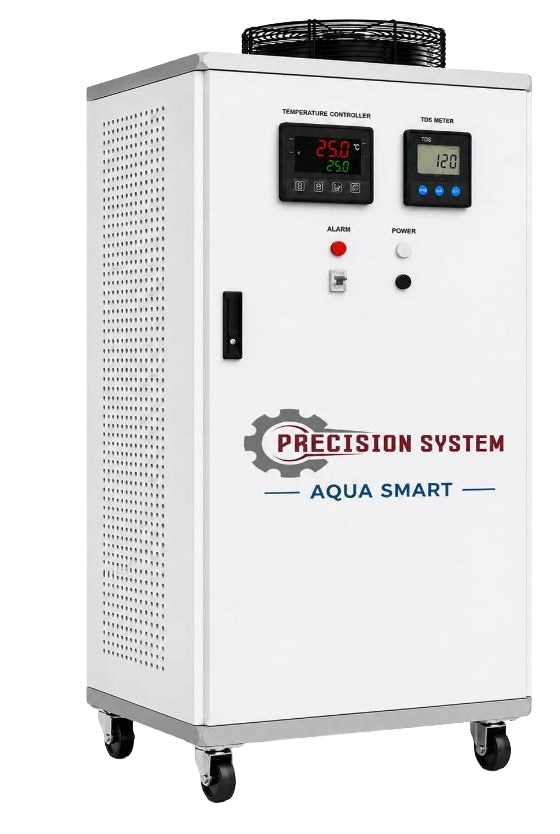
PRECISION AQUA SMART is a water temperature and conductivity (TDS) controller for jet, spot and line cooling. It closes the loop on your existing or new jet cooling machine.
Die casting drifts. Water warms, conductivity climbs, scale builds inside cooling channels and jet coolers — heat transfer drops, die temperature creeps up, and shrinkage porosity comes back even though nothing on the machine changed.
Controlling the water is what keeps the cooling you bought working. It also cuts water consumption cost, and it is fully automatic.
How it works
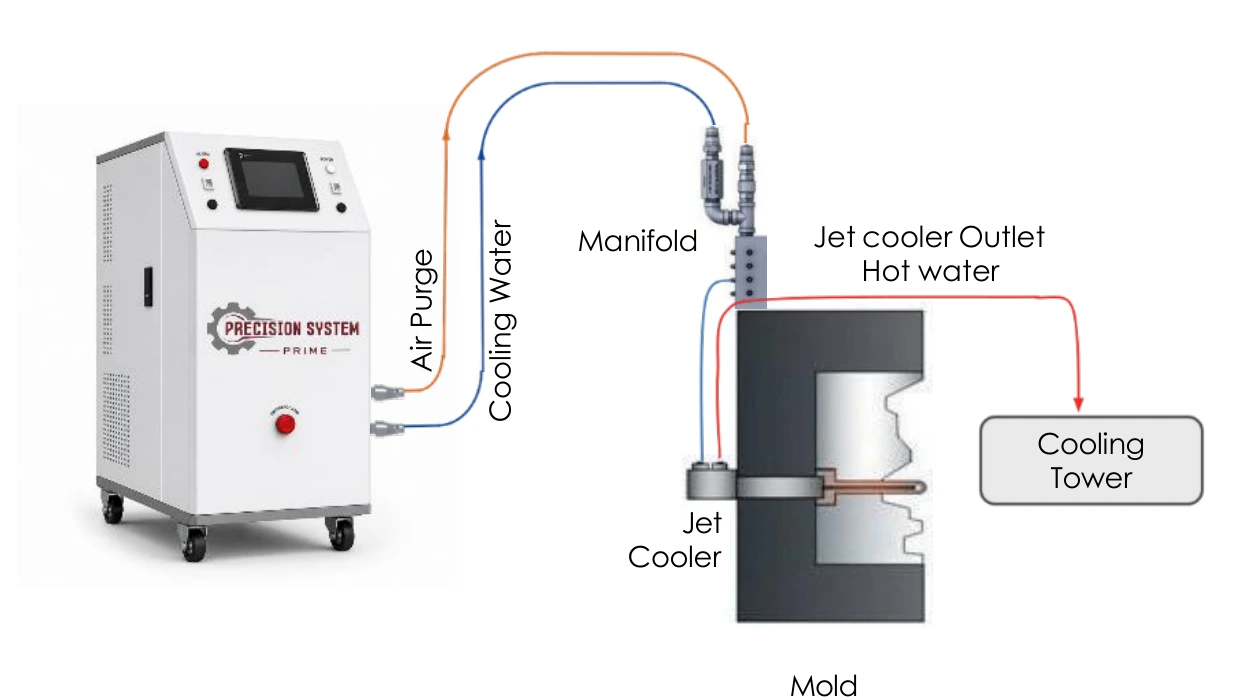
Cooling water is driven through a manifold to jet coolers seated in the die's hottest sections. Hot water returns to the tower; an air purge clears the lines between shots.
Compare the range
The same table your engineers would read in the printed catalogue. PRIME and NEO cool the die; AQUA SMART conditions the water that feeds them, which is why its column reads differently.
Source: Precision System Equipments Catalogue, Edition 2025, p.6. Scroll the table sideways on a narrow screen — the specification column stays put.
| Technical specification | PRECISION PRIME | PRECISION NEO | PRECISION AQUA SMART |
|---|---|---|---|
| Core pins cooledNos | 20 | 204060100 | 204060100 |
| Cooling channelsNos | 02 | 020406 | 01 |
| Inbuilt temp controlled | No | No | Yes |
| Inbuilt deionizer | No | No | Yes |
| Flow rate measure / channel | No | Yes | No |
| Air & water pressure measure | Yes | Yes | No |
| Core pin breakage detection | No | Yes | No |
| Curve per channel display | No | Yes | No |
| Error diagnostic & recording | Yes | Yes | No |
| Touch screen HMI | Delta 7″ | Mitsubishi 7″ | No |
| Data storage & transfer mold / production |
05/200 | 16/200 | No |
| Water tankL | Not specified | Not specified | 60–200 |
| Standard / certified | Not specified | Not specified | Not specified |
| Cooling capacitykW | No | Yes | 12 – 26 |
| Amount of water process (at 200 ppm) | No | Yes | 2000 L |
| Earth leakage protection & detection | No | Yes | No |
| Protection against residual voltage, earth fault, residual current circuit break | No | Yes | No |
| Over / under voltage protection | No | Yes | No |
| Dimension (H×W×D)mm | 1000×600 | 1000×700 | 1300×800 |
Sizing, channel selection and mold-side hardware are quoted against your die. Send us your drawings.
The loop, drawn
What changes when you jet cool
Less shrinkage porosity means fewer pressure-leak failures, less scrap, and less drilling & finishing to rescue borderline parts.
Handled hot spots mean less soldering and erosion on core pins, longer die part life, and less mold maintenance downtime.
Sound thin-section castings open the door to critical, higher-margin parts — and position you as a technology-led caster.
Typical applications
Anywhere thick-to-thin transitions and core pins create hot spots — across IC, EV and structural castings.
Why cooling discipline is also a safety issue
Water that reaches molten aluminium (~660 °C) flashes to steam and expands violently — industry safety literature treats water-in-melt as an explosion hazard. A broken core pin can inject pressurised cooling water straight into solidifying metal. That's why our machines purge lines with air between shots, and why cooling equipment should always be engineered, not improvised.
Common questions
Yes. The machine only needs a potential-free shot signal from your DCM. Once it receives the signal, it runs the cooling recipe you've set for that mold — independent of the machine's make or age.
Usually, yes. Converting means modifying core pins and selecting the right jet coolers for your hot zones. Share your mold drawings and our engineers will walk you through what's needed.
These are plug & play machines: mechanical connection to machine and mold is a same-day job for any plant engineer, and the interface is built for operators, not programmers.
Related
Let’s cut your scrap rate
Send whatever you have — a drawing, a photo, a rejection report. An engineer, not a sales script, will come back to you with what we'd actually do.